
Meet David
About David Matthews
Rooted in Ozark. Ready to Fight for Alabama.
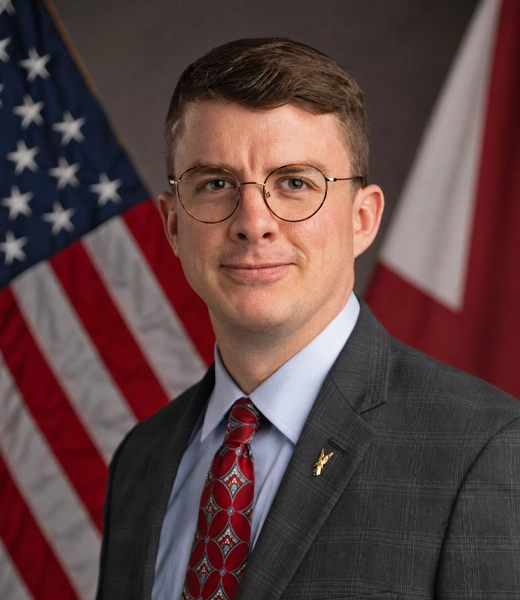
About David Matthews
David Matthews’ path to Congress began in Ozark, Alabama, but it took him through hardship, an unexpected opportunity, and years of service in both Trump Administrations.
After graduating from the University of Alabama just after the 2008 financial crisis, David struggled to find the kind of career he had worked toward. He waited tables and worked in kitchens, earning at most $7.25 an hour. There were days when he rode his bike to work because he couldn’t afford gas. Without a steady place to live, he stayed on friends’ couches, on a blow-up mattress, and occasionally in his car.
Those days were tough and uncertain, but they changed how David sees work, opportunity, and public service. He knows what it’s like to work hard and still not see a way forward. He also knows how much things can get better when someone finally gets a chance to prove themselves.
David got his chance in March 2016 when he joined Donald Trump’s presidential campaign as an unpaid field representative. Only three days later, he was promoted to Western Pennsylvania field director, organizing 34 counties in one of the most important swing states in the country, a state no Republican presidential candidate had won there since Ronald Reagan’s 1988 victory.
David continued working for President Trump and served at the U.S. Department of Agriculture during both Trump Administrations as a political appointee. He oversaw federal operations nationwide and helped direct billions of dollars in investments to rural communities.
Today, David and his wife Emily are raising five young children. He’s running to represent Alabama’s 2nd Congressional District because he wants to use his experience in Washington to serve the people and communities that raised him.
Home in the Wiregrass
David was born at Flowers Hospital in Dothan and raised in Ozark. His family has deep roots in the Wiregrass, with generations connected to Ozark, Enterprise, and Abbeville. On the Carroll side of his family, records trace their arrival in the Ozark area to 1833.
Growing up in the Wiregrass meant long bike rides around Ozark with friends, early mornings at the Claybank Jamboree, and trips to the National Peanut Festival every fall. He and his friends fished wherever they could find a good spot and spent nearly as much time debating the best catfish bait. David always made the case for a piece of hot dog and, as far as he was concerned, the results settled the argument.
He got his first deer in Echo and hunted wild hogs near the perimeter of Fort Rucker. Lake Eufaula, the backroads of Dale County, and the small towns scattered across southeast Alabama were not places he came to appreciate later. They were simply home.
Church was also central to his upbringing. David was raised and baptized at First United Methodist Church in Ozark, the same church where he and Emily were later married. Today, they attend Trinity Methodist Church in Ozark with their five children.
The Wiregrass gave David more than memories. It shaped his understanding of family, community, faith, and the responsibility people have to look after one another. Those lessons have stayed with him wherever life and public service have taken him.
Finding a Way Forward
The years after college did not unfold the way David expected. He had earned a degree, was willing to work, and believed he was doing everything he was supposed to do, but he still could not find a clear path into a career.
That season left a lasting impression on him. It taught David that hardworking people can make responsible choices and still find themselves stuck. Effort matters, but sometimes what changes a life is an open door and someone willing to trust you with an opportunity.
For David, that door opened in March 2016 when he joined Donald Trump’s presidential campaign as an unpaid field representative. Within three days, he was asked to take responsibility for organizing 34 counties across Western Pennsylvania. The opportunity forced him to learn quickly, lead under pressure, and prove what he could accomplish. It changed the course of his life and ultimately led him to serve at the U.S. Department of Agriculture during both Trump Administrations.
The campaign also brought Emily into his life. Today, David and Emily are raising five children, ages seven, six, five, four, and one.
Faith remains central to how they approach major decisions. David prays for guidance, though he does not pretend to know where every path will lead. When the opportunity to run for Congress appeared, he and Emily believed they were being called to step forward and give it everything they had. Whether the path leads exactly where they hope or toward a purpose they cannot yet see, David believes their responsibility remains the same: work hard, remain faithful, and make the opportunity count.
Serving in Both Trump Administrations
On January 20, 2017, minutes after President Donald Trump took the oath of office, David was sworn in as a member of USDA’s Beachhead Team (the group of political appointees responsible for helping the new administration take control of the department and begin carrying out the President’s agenda).
David’s first assignment was at the USDA’s Food and Nutrition Service. At the time, he knew little about the inner workings of the federal government and did not even realize that the agency responsible for administering the Supplemental Nutrition Assistance Program (commonly known as “food stamps”) was part of the Department of Agriculture. That changed quickly.
Within his first two and a half weeks, David identified serious problems in the way SNAP’s improper payments had been calculated and reported. His review uncovered several billion dollars in improper payments that had not been accurately reflected in previous reporting. He briefed White House officials, senior USDA advisers, and other members of the Beachhead Team on what he had found.
After these briefings on SNAP fraud and mismanagement, some of his colleagues began calling him “Congressman.” David usually rolled his eyes at the nickname.
It was the first indication of the role David would come to play throughout his government service: learning complex systems quickly, questioning assumptions, and noticing problems that many others had missed.
After his initial assignment at the Food and Nutrition Service, David transitioned to the Farm Service Agency, where he served as a Confidential Assistant and later as a Special Assistant to the FSA Administrator. He worked on major initiatives affecting farmers nationwide, including the Market Facilitation Program, disaster assistance programs, and the implementation of Farm Bill policy. One of his most significant efforts involved modernizing acreage reporting.
For decades, farmers and Farm Service Agency employees were burdened by a slow, paper-heavy acreage-reporting process. During President Trump’s first term, David identified a workable solution, but two major corporations mounted an aggressive lobbying campaign against it, bringing executives to Washington and enlisting members of Congress to intervene. USDA instead pursued a different system that ultimately failed after consuming hundreds of millions of taxpayer dollars.
David’s responsibilities soon expanded beyond the Farm Service Agency. He was selected to serve as USDA’s Deputy White House Liaison, overseeing the department’s 216 political appointees and helping manage the leadership team responsible for carrying out the President’s agenda across USDA.
When David returned to the department during President Trump’s second administration, he brought with him a deeper understanding of how to overcome the bureaucratic, political, and contract procurement issues that had slowed or killed important projects. He brought back the original acreage-reporting initiative, assembled the right players, and helped complete the solution in record time at a fraction of the cost. That new system is expected to launch in the fall of 2026 and will be widely used by farmers across the country in 2027. It will save millions of hours of repetitive work and provide more timely, accurate, and consistent acreage data. This will help with crop insurance, risk modeling, loss adjustment, disaster assistance, and the USDA’s ability to respond to emerging threats.
When he took on the role of Director of State Operations for USDA Rural Development, David put the experience he had gained to the test nationwide. During his time at USDA, he learned how federal decisions are made, why good ideas get stuck in bureaucracy, and what it takes to turn a plan into action. This experience gives him a unique understanding of the Executive Branch that few candidates or members of Congress have.
Delivering Results for Rural America
As Director of State Operations for USDA Rural Development, David helped implement the delivery of 88 loan, grant, and technical-assistance programs across all 50 states, the U.S. territories, and the Freely Associated States.
When he arrived, the State Operations Office workforce under his management included approximately 2,500 employees. David had 53 direct reports, including 47 executive State Directors who led Rural Development programs across the country.
During his tenure, a series of voluntary resignation programs led to the largest workforce reduction in Rural Development’s history. Staffing declined by approximately 42 percent, eventually falling to about 1,475 employees.
David’s main responsibility was to ensure Rural Development could continue to function after losing nearly half of its workforce.
He knew simply asking the remaining employees to work harder wouldn’t be enough. David set up new systems, changed how jobs were defined, led teams through tough changes, and found practical ways to get more done with fewer people.
The agency did more than keep the lights on. During that period, Rural Development invested more than $34 billion in rural communities, and numerous programs reached historic highs in the funding they delivered.
This experience made David believe even more that real government reform isn’t just about cutting waste or making big announcements. What really matters is getting the job done and making sure taxpayers see better results.
This is where David does his best work. He’s willing to take on tough, complicated tasks that often go unnoticed. He reads the fine details, figures out how everything fits together, builds systems that work, and sticks with problems until they’re solved.
That same attention to detail helped him uncover waste in Rural Development’s property portfolio. The agency was still paying for leased buildings that had been vacant for years—some for more than a decade. David helped remove those unused properties from the government’s books, saving taxpayers more than $2 million.
For David, fiscal conservatism is more than a slogan. It means asking how money is spent, challenging old habits, and not accepting “that is how we have always done it” as an excuse.
Understanding Rural Development from Both Sides
David has also worked with rural businesses and communities outside of the federal government.
As a USDA business development officer in the private sector, he helped business owners and small communities pursue government-guaranteed financing through USDA Rural Development and the Small Business Administration loan and grant programs.
His work included projects involving manufacturing, healthcare, meat and food processing, energy, logistics, hospitality, and essential community facilities.
By working directly with financing applications, David saw firsthand how businesses and communities operate. He reviewed profit-and-loss statements, balance sheets, cash-flow projections, collateral, and other financial records that showed why some projects succeed while others struggle to get funding.
That experience gave him a real-world understanding of rural economic development from both sides. He knows how federal programs are designed and managed, but he also knows what business owners, healthcare providers, lenders, and local leaders face when they try to grow, buy equipment, build, create jobs, or offer important services.
David learned about the specific challenges facing industries vital to Alabama’s economy. He saw how unnecessary red tape, unclear rules, limited infrastructure, and gaps in financing can prevent otherwise strong businesses and communities from growing.
Helping rural areas grow takes more than good intentions. It requires access to money, reliable infrastructure, skilled workers, strong local banks, and leaders who can turn ideas into real investments.
David wants to use that experience to support Alabama manufacturers, strengthen healthcare and food-processing capacity, rebuild domestic supply chains, attract new employers, remove unnecessary barriers to investment, and help communities create lasting jobs and prosperity.
Raising a Family in Today’s Economy
David’s reasons for running are also deeply personal.
He and Emily are raising five young children. Their lives involve grocery lists, household budgets, unexpected expenses, and the constant effort required to provide for a large family. They aren’t wealthy. They watch their spending, plan carefully, and make sacrifices to give their children a good life.
That’s why David often talks about how expensive it is to raise a family. He doesn’t just hear about these challenges in policy meetings; he faces them at the grocery store and at home around the kitchen table.
David believes America should make it easier for people to marry, raise children, buy a home, and build a secure future. He supports real tax relief for young families, stronger domestic supply chains, lower costs, and economic policies that reward hard work.
He also wants more young people in Alabama to have the choice to stay close to home. Too many leave because they think they have to pick between being near family and finding a good job.
When David’s children grow up, he wants them to live in Alabama, where costs are lower, job opportunities are more abundant, neighborhoods are safer, and there is a renewed sense of hope.
Protecting Army Aviation and the Wiregrass
Fort Rucker and Army Aviation have always been part of David’s life.
His mother worked at Fort Rucker as a logistics manager. His grandfather met his grandmother while stationed there. Many of David’s friends have built careers working on Chinook and Apache helicopters.
The base is more than an economic resource. It’s part of the history, culture, and identity of the Wiregrass.
David believes southeast Alabama should stay at the center of Army Aviation as military technology evolves. That means protecting Fort Rucker’s current missions and preparing the region to lead in unmanned aircraft, advanced aviation training, maintenance, manufacturing, and new defense technology.
The Wiregrass is home to exceptional mechanics, instructors, civilian employees, and aviation professionals. David wants future defense investments to build on that talent and create new opportunities throughout the region.
He will also advocate for the service members, veterans, military spouses, civilian workers, and families who sustain the mission every day.
Why David Is Running
David never spent his life planning to run for Congress.
When people asked when he was going to run for office, David always gave the same answer: “It will not be anytime soon. But if the door opens and the path is clear, I will step onto it.” He thought that opportunity, if it ever came, would be many years after President Trump’s second administration.
Then, on May 20, 2026, David learned that Alabama’s congressional map was redrawn and was encouraged by others to consider running. He began speaking with colleagues in the Trump Administration, veterans of President Trump’s Presidential campaigns, trusted mentors, friends, family members, and his wife, Emily. After those conversations, the path became clear. David and Emily believed they needed to step forward.
David entered the race because Congress needs members who understand more than how to introduce a bill, cast a vote, or deliver a catchy speech. Congress is also responsible for overseeing the federal agencies that spend taxpayer money, administer national programs, and carry out the laws.
Too often, legislators arrive in Washington knowing what they want the government to do but with little practical understanding of how the Executive Branch actually works or why it often falls short.
David has spent years learning and working inside those systems at the most detailed level. He understands federal personnel, contracting, technology, program delivery, organizational reform, and the specific bureaucratic obstacles that prevent good ideas from becoming results. He knows where decisions are made, how money is spent, where accountability breaks down, and what it takes to move an initiative from conversation to completion.
David was never part of Washington’s political class. He was a man from Alabama, put in a unique environment and given the opportunity to learn things that very few Americans, and surprisingly few members of Congress, ever learn.
That knowledge can now be put to work for Alabama. David can use it to expose waste, hold federal agencies accountable, remove unnecessary barriers, and help the government operate more effectively with fewer taxpayer dollars. He knows how to make government work for the people rather than the other way around.
David Matthews is running for Congress to give the people of Alabama a rare opportunity: to send one of their own to Washington with the detailed knowledge, proven experience, and personal determination needed to change how the federal government works.
He will not need years to discover whom to call, where authority rests, or why an Alabama community’s project has become trapped inside a federal agency. He can begin serving effectively on day one.
Experience That Delivers
From the front lines of the Trump Administration to the heart of Alabama — a career spent making government work for the people who pay for it.
-
2025–2026
Director of State Operations, USDA Rural Development
Leads national operations across all 50 states and every U.S. territory, overseeing program integrity and delivery for 88 federal loan, grant, and technical-assistance programs.
-
2017–2021
USDA Farm Service Agency & White House Liaison’s Office
Helped administer the Market Facilitation Program and disaster assistance for farmers, implemented Farm Bill programs, modernized acreage reporting, and launched Farmers.gov — while pushing accountability on costly, unused leases and improper payments.
-
Private Sector
Rural Lending & Development
Helped rural businesses, farmers, and communities unlock growth through USDA- and SBA-backed programs, using both financial and policy expertise to drive economic development.
-
Ozark
Rooted in the Community
Past president of the Ozark Rotary Club, supporter of the Boys & Girls Club, University of Alabama graduate, and published author.
Join the campaign
Get updates from David and ways to help bring common-sense conservative leadership to Alabama's 2nd Congressional District.